University coursework
biopipes
- Goal
- Take WGS, RNAseq and ATACseq from raw reads through to one integrated multiomics readout
- Inputs
- Raw, demultiplexed sequencing reads from three assays
- Outputs
- Per-assay processed results, an integrated multiomics analysis, and the report figures
- Tools
- R, bash
What it does
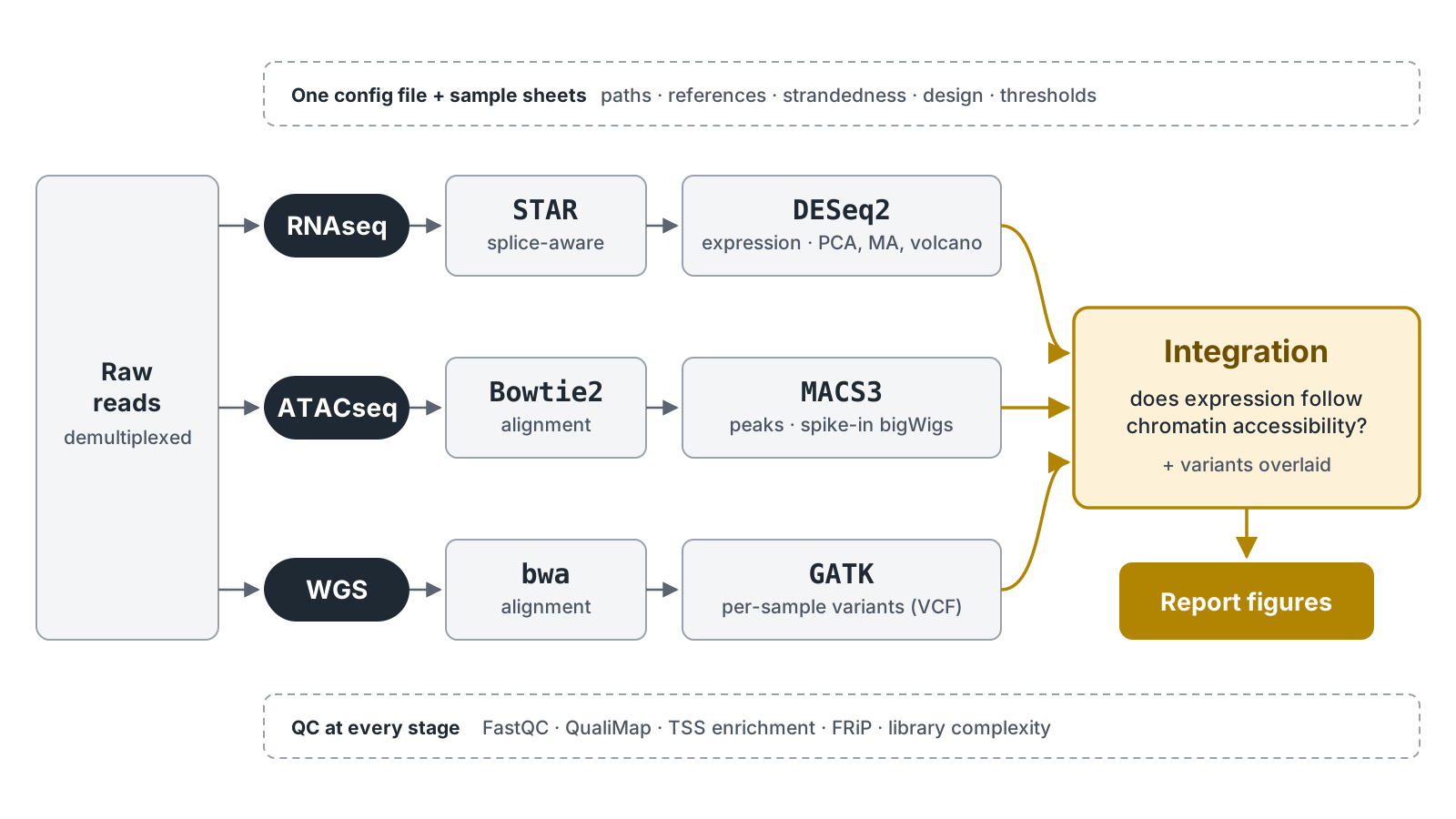
Four modules of bash and R scripts that, run in sequence, cover the whole path from raw demultiplexed reads to integrated multiomics results and the plots that go into the report. It handles WGS, RNAseq and ATACseq, and converges the three into a single integration step.
Why it exists
It was built for a specific question: whether a treatment was having an effect on drug-resistant cancer cells. The project behind it asked whether HDAC inhibitors could re-sensitise cisplatin-resistant small-cell lung cancer cells. No single assay answered that on its own - the effect had to be read across genome, transcriptome and chromatin accessibility together. That meant the three pipelines could not just run side by side; they had to produce outputs that were actually integrable.
How it works
Each assay answers one question and ends in a concrete output. RNAseq asks which genes change between conditions and ends in DESeq2 results with PCA, MA and volcano plots. ATACseq asks where chromatin is open and whether the library is usable, and ends in MACS3 peaks, spike-in normalised bigWigs and QC metrics. Variant calling asks which variants each sample carries and ends in per-sample GATK VCFs. The integration step asks whether expression and accessibility move together, and overlays the variants on that.
A few choices carry most of the weight. Alignment is splice-aware (STAR) for RNAseq and standard (bwa, Bowtie2) for the DNA assays. ATACseq is normalised against a Drosophila chromatin spike-in. QC is a first-class output, not an afterthought (FastQC, QualiMap, TSS enrichment, FRiP, library complexity). DESeq2 takes a configurable multi-factor design for both expression and differential accessibility.
Current state
Public and MIT-licensed. All configuration lives in one file plus the sample sheets - paths, references, strandedness, design and thresholds - so nothing is tied to the original dataset. One conda environment and a shared shell library keep runs reproducible. The RNAseq, ATACseq and variant-calling pipelines and the integration step are validated; next on the roadmap are MultiQC aggregation, consensus peaks, VQSR filtering and joint genotyping.