Master thesis work
gemAGT
- Goal
- Find which reactions make a genome-scale metabolic model fail, without re-running curation notebooks cell by cell
- Inputs
- A genome-scale metabolic model and a curation goal stated in plain language
- Outputs
- The reactions responsible for the failure, reached through an agent-driven curation loop
- Tools
- Python, COBRApy
What it does
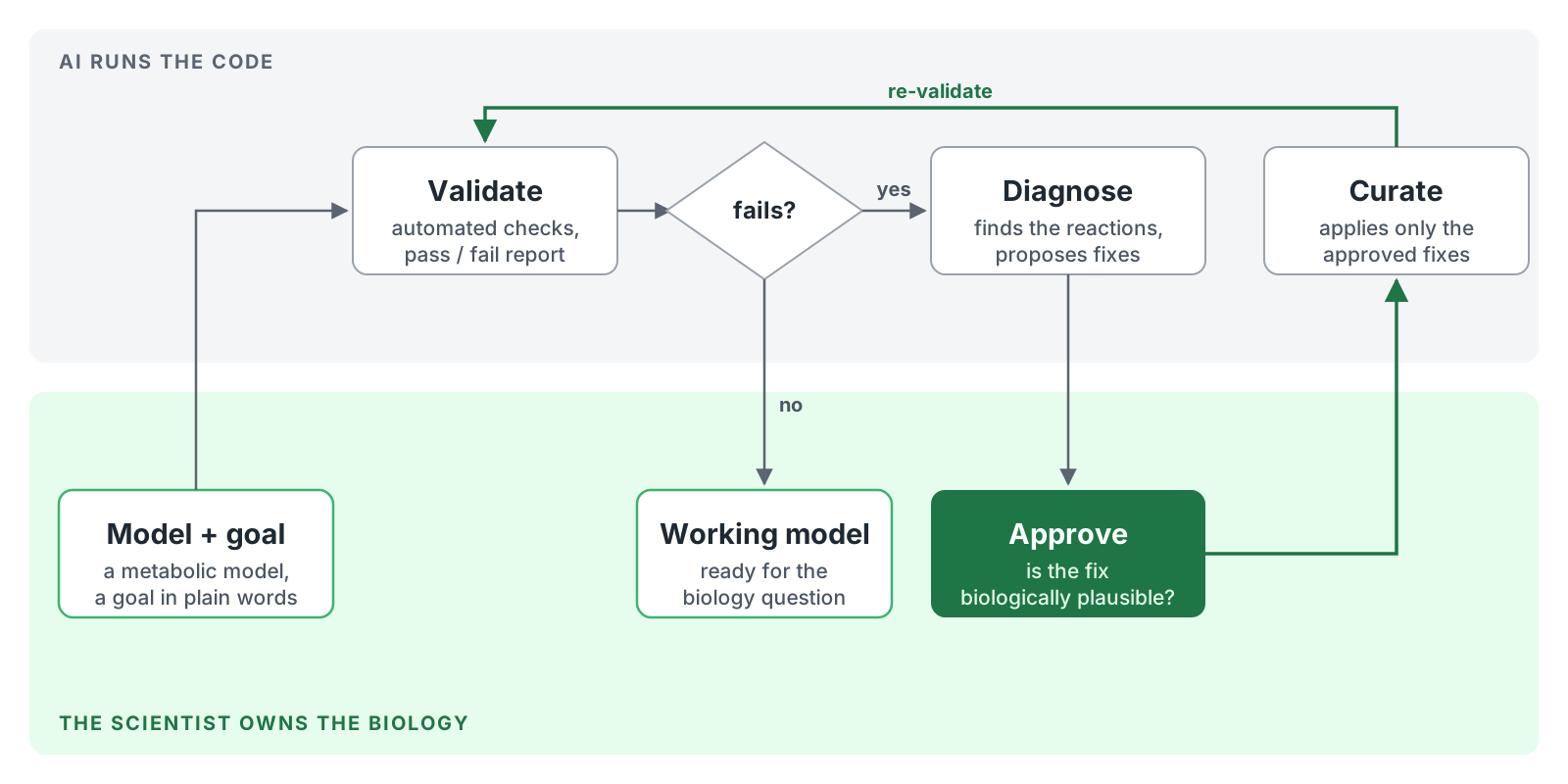
It points at the reactions that are making a genome-scale metabolic model fail, turning a manual search that takes hours into a query that takes minutes. A set of defined functions and AI skills wraps the curation work in an agentic environment, so the model can be interrogated with minimal direct coding.
Why it exists
It came out of Master Thesis work on metabolic model curation. The daily reality was re-running the same validation and curation cells by hand, changing one parameter at a time, trying to work out why a model was not behaving as expected. That loop is slow, repetitive, easy to lose track of - and none of it is the actual biology. Handing the mechanical half to an agent seemed worth trying.
The scientist owns the biology while AI runs the code.
That is the whole design principle. Judgement about whether a curation result is biologically plausible stays with the person; the repetitive execution does not.
Current state
Public and usable for its purpose, and still under active development. The current work is validation rather than features: running curation on freshly reconstructed genome-scale metabolic models and comparing the results against models that are already curated, to establish how reliable the output is when the goal is stated clearly. Until that comparison is complete, treat its suggestions as leads to check rather than final answers - the tool is shared on that understanding.