· 5 min read
Using data to understand biology - and to decide better
Who I am: a biologist and bioprocess engineer moving into bioinformatics, what I am working on now, and what this blog will be about.
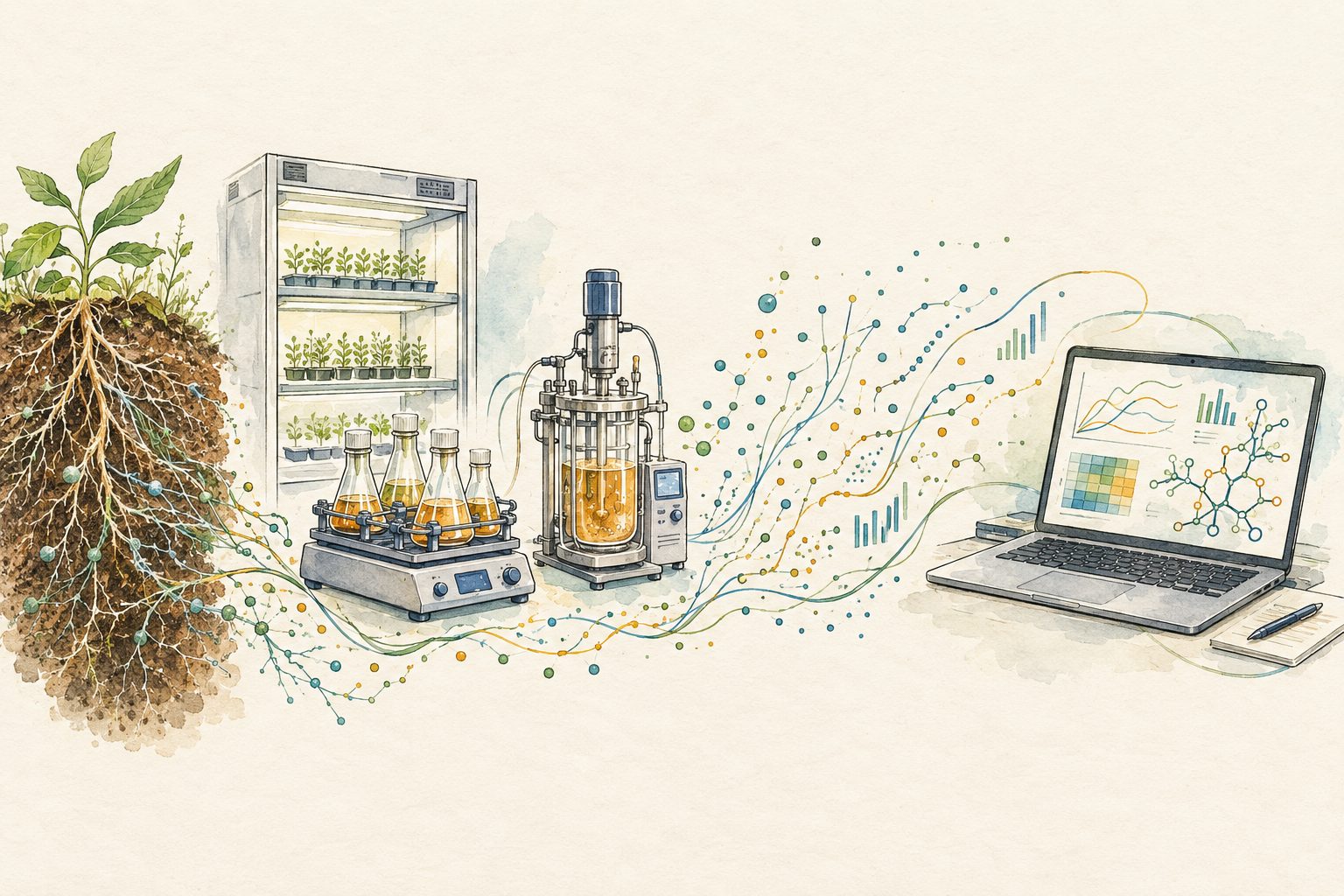
If someone asks me what I do, my short answer is this: I use data to understand biology and predict how it will behave, so we can make better decisions about it.
It took me a while to be able to say that. I studied biology, and almost all of my working life has been on the wet side. I started with arbuscular mycorrhizal fungi in soil, moved on to lab and growth-chamber experiments, and then spent more than three years developing fermentation processes, first in pseudo-solid-state cultures in vitro and later in liquid. I still think like someone who has run the experiment. But somewhere along those years, the problems that interested me most stopped being in the flask and started being in the data.
Where the data came in
As a bioprocess engineer, I kept having the same feeling: there was more in our data than a spreadsheet could ever show me, and even getting that little out took far too long.
Two projects made it impossible to ignore. In one, I had developed several formulations of a biological herbicide, trying to make it work better and last longer on the shelf, and I needed to estimate their D50 to compare the approaches fairly. In the other, I was going through lab-scale and shake-flask runs, tweaking the process and the medium to get an organism to make more of a secondary metabolite. Both times, the answer was in the data. And both times, Excel was the slowest possible way to get to it.
So I started with Python. At first it was just to automate the boring parts and get some of my time back. Then something I didn’t expect happened: I could suddenly do analyses that were out of reach before. I could plot things properly, spot patterns I would have missed, and actually test the questions I had.
I wanted more of that. I took online courses and kept learning on my own until that wasn’t enough either. Using the methods was no longer the point. I wanted to understand how they apply to the things I care about: getting the most out of a bioprocess, using genetic information to understand cells better, integrating omics data and building models from it. That is how I ended up in the master’s I’m finishing now, in OMICs technologies and data science in biomedicine.
There’s a longer story behind that move, about what I kept from the bench and what I had to unlearn. That’s the next post.
What I’m doing now
These days I’m juggling two things.
The first is my master’s thesis, on genome-scale metabolic models. The topic was new to me, and it made me change the way I look at problems. I had to switch from wet-lab to dry-lab thinking: new approaches, new skills, new vocabulary. Setting up a virtual experiment isn’t the same as setting up a real one, even when you’re asking the same question. Every week it feels a bit more natural.
The second is the rest of the degree, which is still going. It keeps opening new corners of the field for me. Some of them excite me because of what they make possible. Others are a reality check on where the methods still fall short. I want to write about both.
In my free time I keep learning through side projects, mostly because I enjoy it. I build AI agents for specific tasks, and I build neural networks to understand what’s really going on inside them. Most of it is still in progress and not published anywhere. It’s my way of getting into the topics I think will matter most.
What’s still hard
The foundations. The tools I use now are built on a lot of maths, a lot of jargon and a technology stack I simply didn’t know existed when I was on the wet side, especially around machine learning, neural networks, modelling and AI. Running a tool is the easy part. Knowing what’s underneath it, and so knowing when not to trust it, is what I’m still working on.
The decision I’m glad I made
What I’m proudest of so far isn’t a project. It’s the decision itself: going after what I believed could bring more value to my field instead of staying where things were comfortable and familiar. It meant jumping into cold water again and being a beginner again. It also meant learning new ways to look at situations I thought I already understood. I’d do it again.
Why I want to work between the two worlds
When you use data properly, with the right tools, it lets biologists understand and predict behaviour much faster than lab work alone ever could. I love both of these worlds, and what excites me most is being the link between them. Even more so now that I’m starting to see what new technologies and approaches could do, not only for industry but for health and medicine, and in the end for all of us.
What this blog will be
I’ll post roughly every two weeks, and the posts will be of two kinds. Some will be stories like this one. Most will be about what I learned while building the projects on this site: what each tool can do, where it breaks, what worked, what didn’t, and what I would do differently. If you work where biology meets data, I hope you find something useful here. And if you see things differently, I’d really like to hear it.